
It’s funny, isn’t it, how you don’t see things that are right in front of you?
My Dad was diagnosed with COPD years ago. I have no idea how many years as breathing issues have always been part of Dad. He smoked for years, he coughed a lot, he gave up smoking, he then had inhalers and struggled a bit, but it was just ‘Dad’s breathing’.
Last year my aunt died and at her wake, three different people came up to me to ask what help Dad was getting health wise, and I looked at him through their eyes and realised that his breathing wasn’t a ‘bit worse’ it was ‘alot worse’. And we’d been so caught up trying to look after Mum we’d not thought about it as much as we should. But I didn’t really have a clue what to do or how to do it. In the end…
- I did some research into COPD – the different stages, what they mean, how they are assessed etc.
- I talked to Dad and discovered he’d not had any tests on his breathing since before Covid (he’d had some appointments with a COPD nurse at his surgery who – amongst other things – had told him he was not to use his emergency medication too often, or he wouldn’t get any more. He refused to see her again), so we didn’t know what stage he was at.
- I volunteer for a hospice where I live (a different county) and as part of my training knew that at some stage (I’d assumed in the far away future) Dads COPD would make him a candidate, so I called Dads local hospice to establish what their criteria were for taking on a patient and how to do that.
- And from all that I worked out that he needed the tests the GP hadn’t been organising in order to establish what stage his COPD was at and in turn, whether we met the hospice criteria.
Now, this is a hard one to write – not least because I know as one of my biggest blog cheerleaders, my Dad will read it. However, I assume that I am not the only one who didn’t know all this, and I hope the information in this post will help others as you don’t know what you don’t know, do you? Dad has given his permission to share this so other people can benefit from it.
The important bit to know here is that hospices are not just places people go to die. They support people with a diagnosis that they won’t get better from to live the best possible life they can. Different hospices have different timelines for this – the hospice local to me takes clients with potentially a few years life expectancy, others support people in what is expected to be the last year of their life.
So, next steps:
I pulled together all the research I had, referencing the NHS website (no Dr Google that could be refuted), added the information the hospice had supplied, and emailed my Dad’s GP. At this stage I didn’t have the right to request that they talk to me , but I was quite…let’s say ‘assertive’ in my email, setting out my expectations very clearly.
To cut a very long story short, Dad had his tests and the GP referred him to the hospice immediately and… (important bit coming up)…
…The hospice were bloody amazing.
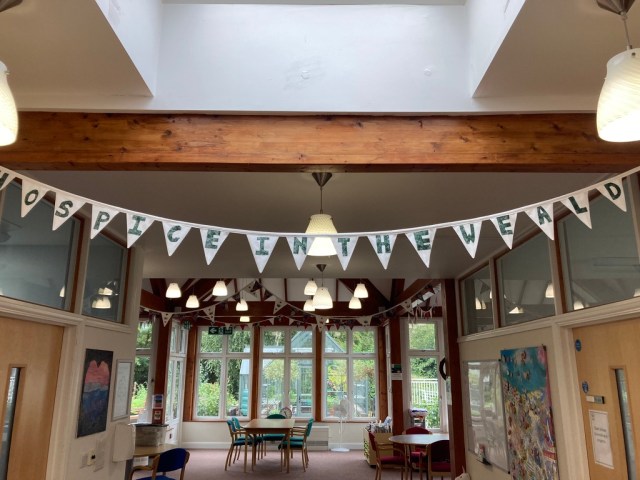
They called Dad, connected him to my previous enquiry call and then called me. They set up an appointment for him with a nurse practitioner and in that hour or so with that nurse she:
- Put Dad in a different frame of mind about what a hospice does.
- Talked through their role in managing Dads COPD.
- Set up an appointment with the physio to give him exercises to support his breathing
- Talked through the concept of a DNR (Do Not Resuscitate), filled one in with his wishes, printed it for him to have a copy at home and put it on the system so it’s on records available to all heath staff whether he is in hospital or hospice.
- Applied for his Attendance Allowance.
- Applied for his Blue Badge.
- Reassured him that he can take his emergency medication as often as emergencies occur – there is no limit as the surgery nurse had said.
- Organised for Dad to have daily Ensure drinks – to build him up a bit as he is a skinny malinky.
- Contacted his GP to request a referral to the respiratory team (which the hospice assumed he’d been under for years, but nobody had ever mentioned it).
- Oh, and they gave us cake too. We especially liked that bit. 🙂
Dad has the option to join Living Well sessions (exercise classes, art sessions, gardening sessions etc), but he doesn’t really like people 🤦🏼♀️ so he’s declined these.
Dad is a ‘patient initiated’ hospice client. That means at this point we can call the hospice at any time we need support, and they don’t contact us other than at our request.
It’s meant – for example – when dad had a particularly bad episode with his breathing and I called the GP the actual words the receptionist said was ‘well, I don’t know what you want me to do about it’. I called the hospice and they arranged for a nurse to call my back within thirty minutes to confirm that he should take his emergency medication (that the surgery nurse made him think he shouldn’t), gave a bit of advice on other things that would help, and arranged for someone to call Dad in a few days to make sure he was doing ok. The difference in care is phenomenal. And that is just one small example.
None of this information is signposted anywhere. It was coincidence and bloody mindedness that got us to where we are. And I imagine there are many people out there who, like me, didn’t know what they didn’t know. So, I hope this helps you if you are one of those people.
What is the tip here?
- Know that hospices are not just about dying; they support their patients receiving palliative care in a way that GPs just don’t / can’t.
- So, if someone you care for has a life limiting diagnosis, contact your local hospice to find out if they support that diagnosis (different hospices support different illnesses) and what criteria needs to be filled to be accepted as a patient.
- Find out who needs to make the referral (usually GP or other health professional)
- Formally request that – if appropriate at this time – the health professional makes that referral (I’m starting to find that request in writing are far more effective than verbal ones as nobody can ‘forget’ them in the same way)
- Be ready to have life made easier while it’s being a bit tricky.
Resources:

 the pog blog